Tutoring Progress Report Template (Free Word and PDF, 2026)

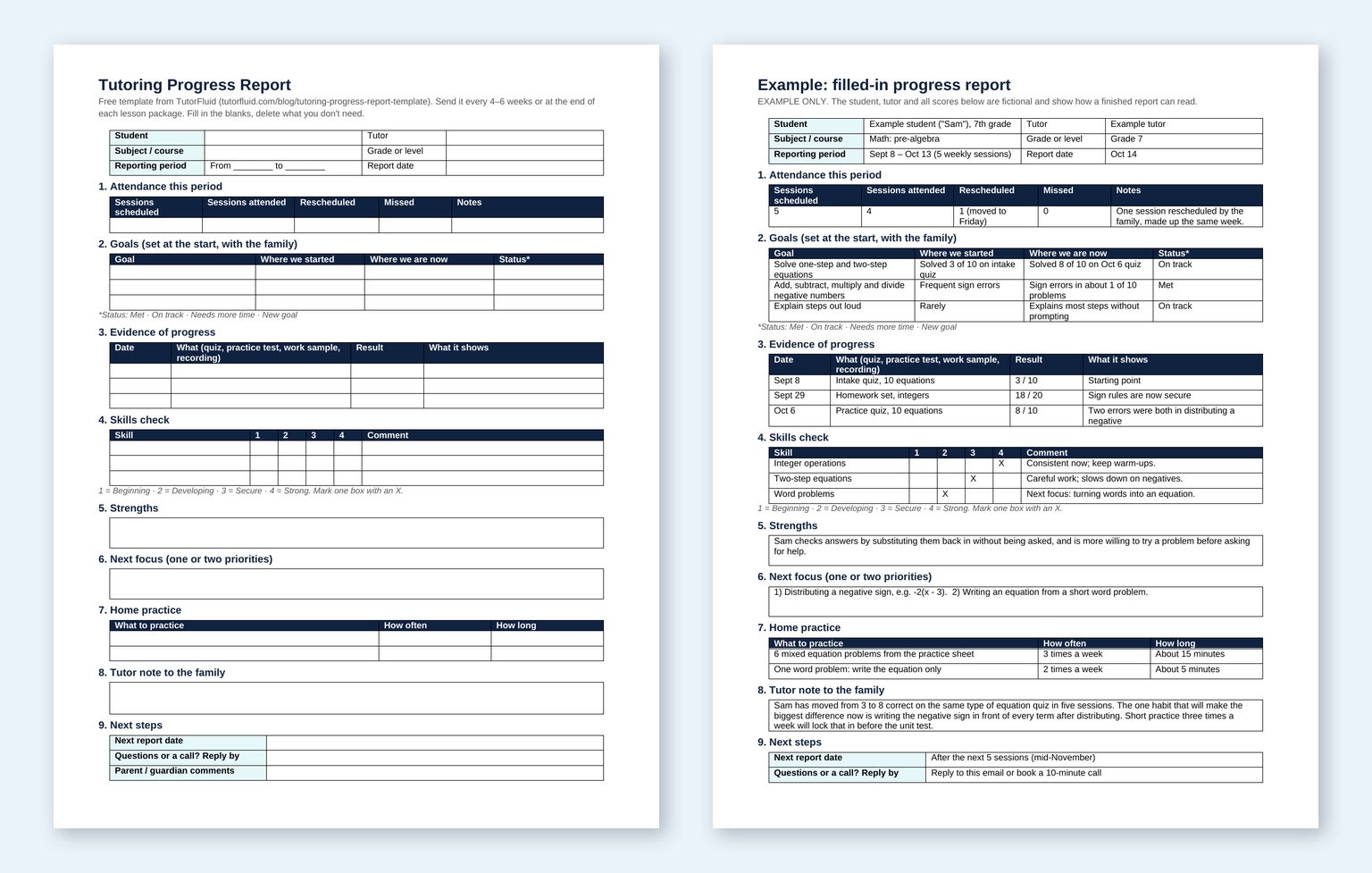
A tutoring progress report template should fit on one page and answer four questions a parent actually has: did my child show up, what were we aiming for, what changed, and what happens next. The free template below does that in nine short sections, built for one-to-one tutoring rather than school report cards. Download it as Word or PDF, or copy the version on this page.
Send it at the end of each lesson package, and the report becomes the natural moment to book the next one. That's where TutorFluid helps: families book and pay upfront from your own booking page, and a unique video link is created for each booking automatically. It's $9.99/month after a 45-day free trial, with 0% commission.
A tutoring progress report is a short written update to a student's family that compares where the student started with where they are now, against goals you agreed on, and names the next step.
Download the free template
- Download the Word template (.docx). Edit it in Word, or upload it to Google Drive and open it with Google Docs.
- Download the PDF to print it or fill it in by hand.
The file has three pages: the blank one-page report, a filled-in example, and a short monthly email version with the comment starters from this article.
What goes in a tutoring progress report
Most templates that rank for this search are generic school forms. A tutor's report has a different job. You see one student, often once a week, toward goals the family asked for. So the sections follow that:
| Section | What to write | Why parents care |
|---|---|---|
| Student details | Student, subject, grade, tutor, reporting period, report date | Ties the report to a clear stretch of time |
| Attendance | Sessions scheduled, attended, rescheduled, missed | Shows what the family paid for and what happened |
| Goals | Each goal set at the start, where you started, where you are now, status | The heart of the report: progress against what they asked for |
| Evidence | Dated quiz scores, practice tests, work samples, recordings | Turns "doing better" into something they can see |
| Skills check | 3 skills rated 1–4 (Beginning, Developing, Secure, Strong) | A quick read for busy parents |
| Strengths | One or two specific things going well | Gives the family something to praise at home |
| Next focus | One or two priorities, no more | Shows you have a plan |
| Home practice | What, how often, how long | The part parents can actually help with |
| Tutor note and next steps | A few plain sentences, the next report date, how to reply | Opens the conversation about continuing |
Copy-ready version
If you'd rather paste it into an email or document, here is the same template in text form:
Tutoring Progress Report
- Student: ______ Subject: ______ Grade/level: ______ Tutor: ______
- Reporting period: from ______ to ______ Report date: ______
1. Attendance: Sessions scheduled ___ · Attended ___ · Rescheduled ___ · Missed ___ · Notes ______
2. Goals (set at the start, with the family)
| Goal | Where we started | Where we are now | Status (Met / On track / Needs more time / New goal) |
|---|---|---|---|
3. Evidence of progress
| Date | What (quiz, practice test, work sample, recording) | Result | What it shows |
|---|---|---|---|
4. Skills check (1 = Beginning, 2 = Developing, 3 = Secure, 4 = Strong): Skill ______ (1–4) · Skill ______ (1–4) · Skill ______ (1–4)
5. Strengths: ______
6. Next focus (one or two priorities): ______
7. Home practice: What ______ · How often ______ · How long ______
8. Tutor note to the family: ______
9. Next steps: Next report date ______ · Questions or a call? Reply by ______ · Parent/guardian comments ______
A filled-in example
This example is fictional. The student, tutor and every score are made up to show how a finished report reads. It's also page 2 of the download.
- Student: Example student ("Sam"), 7th grade · Subject: Math, pre-algebra · Period: Sept 8 – Oct 13 (5 weekly sessions)
- Attendance: 5 scheduled, 4 attended, 1 moved to Friday by the family and made up the same week, 0 missed.
| Goal | Where we started | Where we are now | Status |
|---|---|---|---|
| Solve one-step and two-step equations | 3 of 10 on intake quiz | 8 of 10 on Oct 6 quiz | On track |
| Add, subtract, multiply and divide negative numbers | Frequent sign errors | Sign errors in about 1 of 10 problems | Met |
| Explain steps out loud | Rarely | Explains most steps without prompting | On track |
- Evidence: Sept 8 intake quiz 3/10 (starting point). Sept 29 integer homework 18/20. Oct 6 practice quiz 8/10; both errors came from distributing a negative.
- Strengths: Sam checks answers by substituting them back in without being asked, and tries a problem before asking for help.
- Next focus: 1) Distributing a negative sign, for example -2(x - 3). 2) Writing an equation from a short word problem.
- Home practice: 6 mixed equation problems, 3 times a week, about 15 minutes. One word problem (write the equation only), 2 times a week.
- Tutor note: "Sam has moved from 3 to 8 correct on the same type of equation quiz in five sessions. The one habit that will make the biggest difference now is writing the negative sign in front of every term after distributing. Short practice three times a week will lock that in before the unit test."
- Next report: after the next 5 sessions.
Notice what the example doesn't do: it doesn't grade the child, compare them with classmates, or promise a test score. It shows the same measure at the start and now, and names one habit to work on.
How often to send a progress report
Every 4–6 weeks, or at the end of each lesson package, is a good default for one-to-one tutoring. That's a recommendation, not a statistic. We found no study that measures how often private tutors should report. Here is the reasoning behind it.
- It matches how progress is actually judged. The National Center on Intensive Intervention, which advises schools on progress monitoring, says it is "standard to collect progress monitoring data for approximately four to six weeks before making intervention changes," and suggests a trend line once there are at least eight data points over four weeks of instruction (NCII webinar Q&A). A report on that rhythm lands right when you have enough evidence to say something real.
- It matches how families buy. If you sell 5- or 10-session packages and meet weekly, a report every 5 or 10 sessions arrives just before the family decides whether to continue.
- Short updates in between help. In a field experiment by Kraft and Rogers, weekly one-sentence, individualized messages from teachers to the parents of high school students in a credit-recovery program cut the share of students who failed to earn course credit from 15.8% to 9.3%, a 41% reduction. Messages about what students could improve had the largest effects (Economics of Education Review, 2015). That was a school program, not tutoring, but the lesson carries over: a short, specific note between reports is worth sending. Use the monthly email version on page 3 of the template.
How to write comments parents read
Keep each comment specific, tied to evidence, and paired with one next step. The Kraft and Rogers result is a good reminder not to stop at praise. A clear "here's what to improve" gave parents something to act on. Copy and fill these:
Strength
- [Name] now [specific skill] without prompting, for example [evidence].
- [Name] improved from [start] to [now] on [measure].
- A habit that is paying off: [habit].
- [Name] is more confident with [topic]; you can see it when [observable behavior].
- The strongest work this period was [task], because [reason].
Growth
- The next step is [skill]; right now [Name] [what happens].
- [Topic] still needs practice: [specific error pattern].
- When [situation], [Name] tends to [behavior]. We are working on [strategy].
- [Name] understands [concept] but needs more speed or accuracy on [task].
- We haven't reached [goal] yet; at the current pace, the next milestone is [realistic milestone].
Next step and at home
- Please ask [Name] to explain [concept] to you once this week.
- [Number] minutes of [practice], [number] times a week, will help most.
- Before the next session, [Name] should [small task].
- For the [test, recital or exam] on [date], we will focus on [priority].
- If [problem] comes up in homework, a quick note to me helps me plan the next session.
Variants for test prep, languages and music
The same nine sections work across subjects. Change what goes in the goals and evidence rows:
- Test prep (SAT, ACT, state tests): use full practice-test section scores as the evidence rows, with the date and the test form. Set goals by section, and keep the target score your student and family chose. For pricing context, see our SAT tutor cost guide.
- Languages: rate speaking, listening, reading and writing as the four skills. Attach a short recording at the start and now as evidence.
- Music lessons: list pieces and technique goals (scales, tempo, sight-reading). A recording is the best evidence a parent can get.
- Short monthly email: use page 3 of the template when a full report is more than you need: attendance, one goal with evidence, one strength, one next focus and the next update date.
Sending it, and making the next step easy
Email the PDF, or paste the short version into an email. For a student who has been struggling, offer a 10-minute call after you send it. Parents read a report differently when they know they can ask about it.
The facts in a report are only as good as your records. If your sessions live in text threads, attendance in a spreadsheet, and payment gets chased after each lesson, counting "sessions scheduled vs attended" for the last five weeks is the slow part. With TutorFluid, that is already in one place:
- Bookings come from your real availability, on your own page at tutorfluid.com/yourname, for single lessons, packages or monthly plans.
- Families pay upfront through Stripe or PayPal, instead of after the lesson.
- A unique video link is auto-created for each booking with Zoom, Google Meet, TutorFluid Video Room or Lessonspace, and added to the confirmation. If a lesson is rescheduled, a fresh link is generated automatically.
- Email and SMS reminders go out for you.
- Your dashboard shows your schedule, upcoming sessions, payments and students at a glance, with messages, lesson credits and rescheduling in one place.
That makes the report's last line easy to act on. If the family wants to continue, they book the next 5-, 10- or 20-session package from your page and pay before the first lesson. TutorFluid Solo is $9.99/month after a 45-day free trial, with 0% TutorFluid commission, and you can build your site without a card. For a team, it's $19.99/month plus $3.99 per additional tutor. TutorFluid doesn't write the progress report for you. That's what the template is for.
The template completes our free set for tutors. Plan the sessions with the tutoring lesson plan template, agree terms with the tutoring contract template, and bill with the tutoring invoice template. Then set rates with how much to charge for tutoring and grow with how to get tutoring clients.
FAQ
How do you write a tutoring progress report?
Start from the goals you set with the family, show where the student started and where they are now with dated evidence, then name one or two next steps and the home practice that supports them. Keep it to one page. The free template above has all nine sections.
How do I comment on a progress report?
Make each comment specific, back it with evidence, and pair it with a next step, for example "improved from 3 to 8 correct on equation quizzes; next, distributing negatives." Use the 15 comment starters above.
How often should tutors send progress reports to parents?
Every 4–6 weeks, or at the end of each lesson package, is a sensible default, with a short email or one-line note in between. This is a recommendation, not a measured standard. It matches the four-to-six-week window NCII describes for judging progress.
What should an IEP progress report look like?
An IEP progress report is the school's legal report, not the tutor's. Under federal special education rules (34 CFR 300.320(a)(3)), each IEP must describe how progress toward the annual goals will be measured and when periodic reports will be given, "such as through the use of quarterly or other periodic reports, concurrent with the issuance of report cards." If you tutor a student with an IEP, your report can support the school's goals, but it doesn't replace that report.
Is this progress report template free?
Yes. Download the Word or PDF file and use it with as many students as you like.
Can I use it in Google Docs?
Yes. Upload the Word file to Google Drive, then open it with Google Docs.
Ready for the next package?
Download the template, send it at the end of this package, and let families book the next one from your own page. Start your 45-day free trial of TutorFluid. It's $9.99/month after that, with no card needed to build your site.